Roleplaying / OLYMPUS 2249
Character creation & karma
Attributes trade off within pairs. Choose one combat and one non-combat specialization; karma determines dialogue options and which quest branches open.
Start with one of the four character presets if this is your first trip into Radius. Olympus 2249 builds deliberately give up something: paired attributes limit each other, specializations shape the problems you can solve, and karma can close a quest route as well as open one. Choose a character whose trade-offs you want to play through, rather than trying to keep every option available.
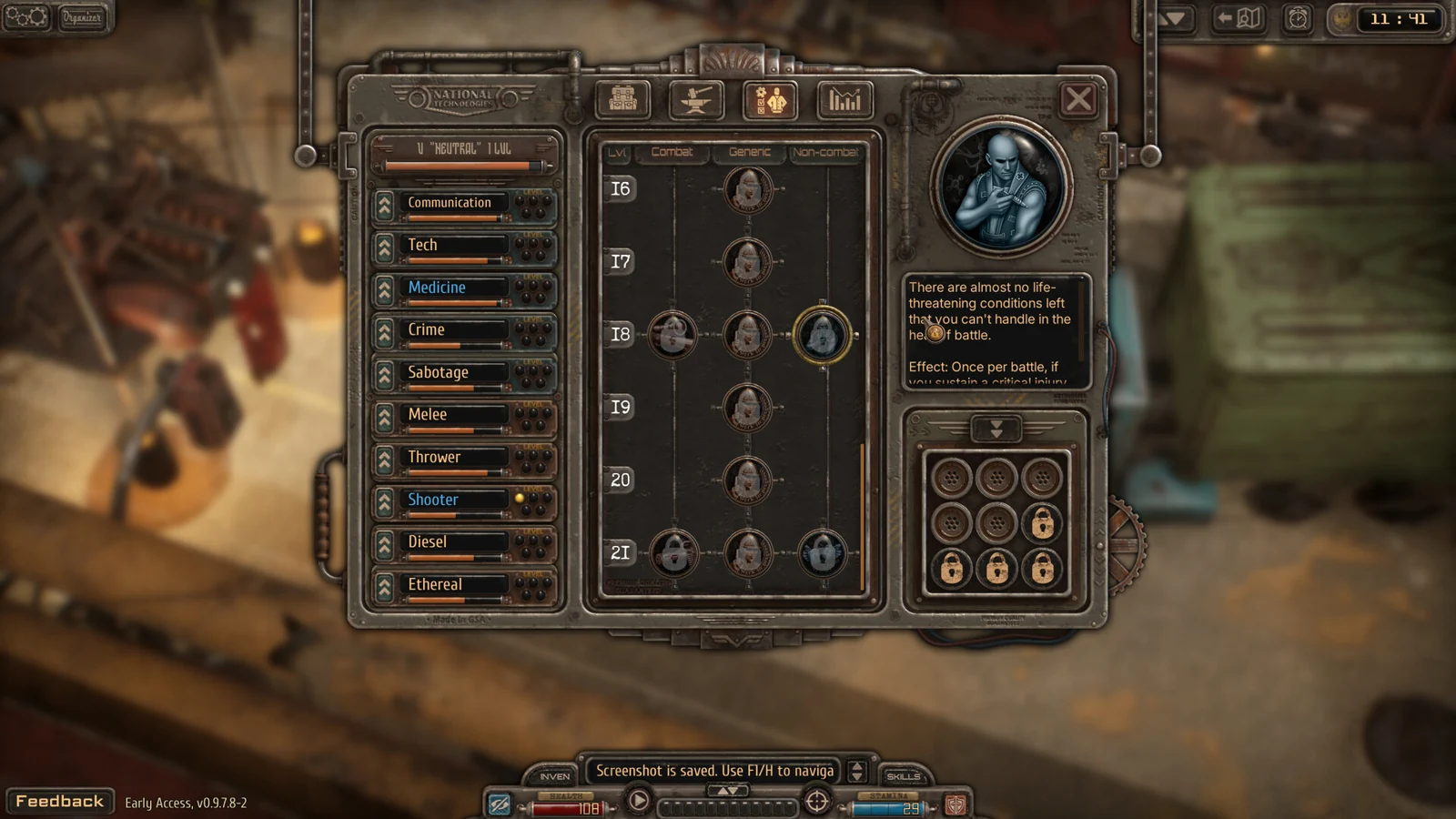
The skills screen separates combat, generic and non-combat progression. Higher-level entries in this image do not mean those perks are complete in the launch build.
Why a preset is the safest first choice
The developer recommends the four presets for an initial playthrough. They give you a coherent starting point while you learn how a weapon, a profession and a personality fit together. That is more useful than a list of supposedly optimal numbers that ignores the quest branches you want to see.
Pick the preset closest to your preferred way of solving a problem. Then read its combat specialization and non-combat specialization before confirming it. The second choice matters immediately: it changes which opening routes make sense. A character who cannot use the tutorial sewer is not automatically a bad build.
If you are making a custom character, describe your aim in one sentence first. You might want to keep enemies at a distance while solving practical problems with technical knowledge. That sentence gives you a way to judge each trade-off. If a choice does not serve it, consider whether you are spending points merely because another option looks attractive.
Paired attributes mean real trade-offs
Attributes sit in opposing pairs. The developer's example is Strength and Agility: setting Strength to 6 caps Agility at 4. You cannot keep increasing both sides as if they were independent stats.
This has a direct combat implication. The developer says Agility helps with action points, but also notes that more AP is not essential for every build. Strength-focused characters need to judge their weapons, position and abilities together, rather than comparing only how many actions fit into a turn.
Setting everything to the middle is not a universal solution. An average character gives up strengths that a specialized character can exploit. Before accepting a pair, ask what your chosen side lets you do and what the reduced side will make harder. Make the rest of the character support that decision.
Do not convert the Strength example into a made-up formula for every stat pair. Read the limits shown by the creation screen as you adjust your own character.
Choose a fighting style and a profession
You choose two specializations during creation: one for combat and one for work outside combat. Selected skills grow faster and grant access to specialization dialogue and perks.
The peaceful profession is not just background flavor. It can determine whether a problem is presented as a repair, medical treatment or another kind of practical task. Checks also happen in the world: being asked to fix a machine can mean interacting with the machine, rather than choosing a conversation response that solves everything.
| Opening problem | Relevant profession | What to do |
|---|---|---|
| Tutorial sewer access | Tech | Examine this route as a technical character. |
| Starting gas mask | Medical | A different character should look for another route. |
| Criminal opening | Criminal | Check the back-door approach and opening directions. |
For the opening troubleshooting sequence, use the prologue guide. Choosing Tech purely to obtain one route is a narrow decision; choosing it because you enjoy repairs and the wider profession is a stronger reason to keep playing that character.
Karma controls available conversations
Karma has five types, stretching from the harshest end to Moralist. Neutral sits between Rascal and Optimist. It changes dialogue, quest access, resolutions and how people react to you.
A character can use the lines of their own type and adjacent types. A Neutral character also has Rascal and Optimist choices. Those neighboring lines are not free previews: selecting them adds points associated with that behavior and can eventually shift your karma.
Treat a response as a decision about who your character is becoming. If you want to remain Neutral, selecting every optimistic response because it sounds polite can take you away from that aim. If you want a gradual personality change, neighboring responses are part of that progression.
Karma can affect more than a greeting. The navigation diary uses the Vultures as an example: a Moralist cannot join them, while an Optimist faces a particularly unpleasant admission quest. An unavailable branch can reflect the character you made rather than an undiscovered item.
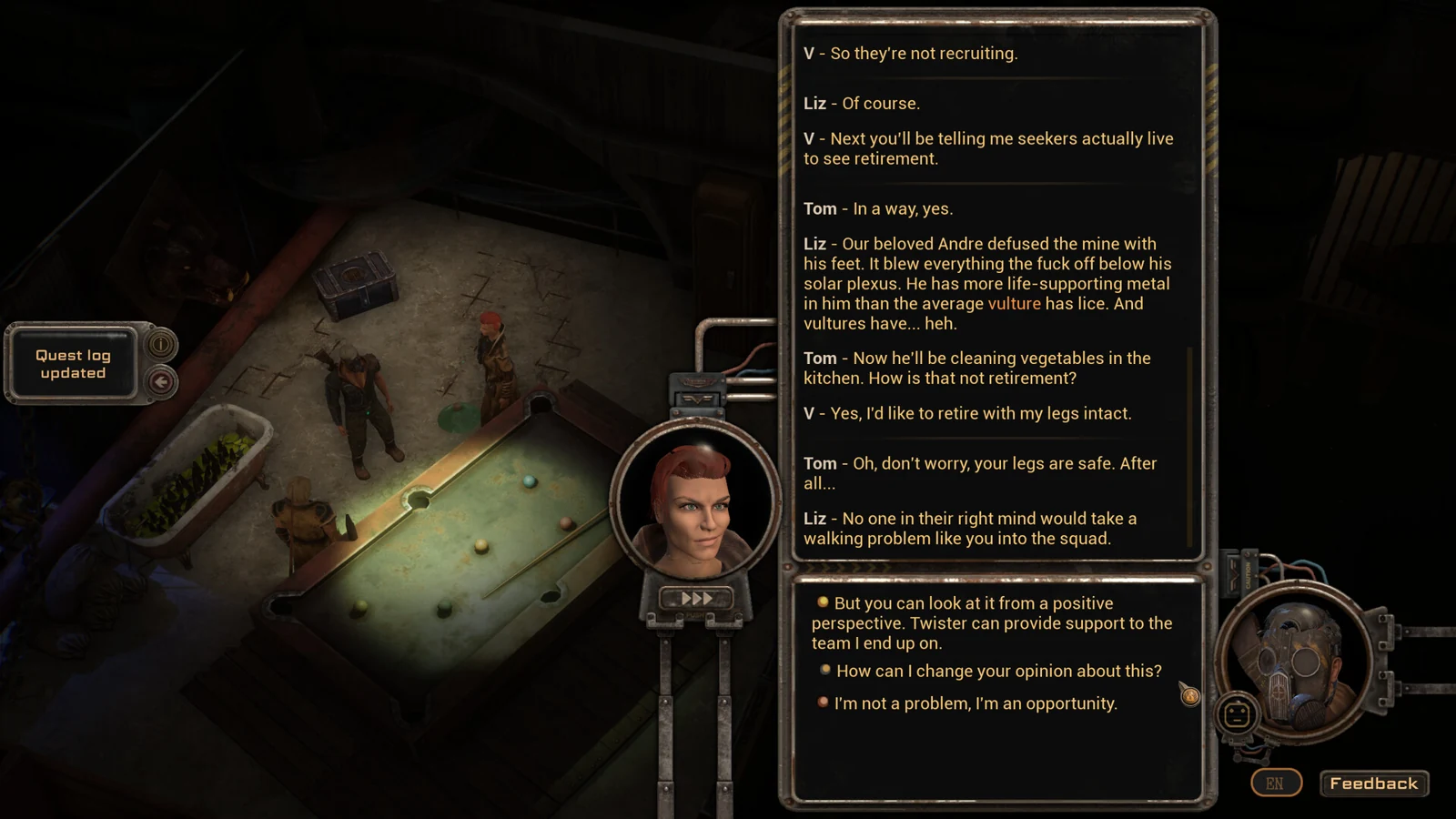
Dialogue options are part of the character system. Read the whole response before choosing it.
Plan perks instead of taking every early unlock
Perks become available as your level rises, but the number you can take is limited and depends on attributes. Some improve a play style; others unlock active combat abilities. An available perk is an option, not an instruction to spend a choice immediately.
Read the effect, then ask which recurring problem it addresses. Does it improve the attack you use? Does it give your character a way out when an enemy closes the distance? Does it support the profession you selected? A perk that solves a frequent problem is more valuable to your run than one that sounds powerful in isolation.
The launch roadmap says perks are complete through level 5. Do not base a first-run plan on a distant perk simply because it appears in a promotional image. The Early Access guide separates current content from longer-term targets.
Progression is more than defeating enemies
Quests are the largest experience source described in the roleplaying diary. Successful hits build combat skill progress, and skill increases contribute to general progression. Exploration reveals training opportunities: the developer points to a shooting range near the hero's home, where shooting bottles gives experience.
That gives you an alternative to forcing an unfavorable fight. Look for useful tasks and discoveries that suit your character. Profession and karma determine the available work; that work can improve the character and change their karma in return.
Before confirming your character
- Pick a fighting style you want to use repeatedly.
- Read the peaceful profession and accept its route consequences.
- Check both sides of each attribute pair after changing a value.
- Choose your starting personality, knowing it can change.
- Prefer a preset if you are still learning those choices.
The goal is a character you understand well enough to adapt. It does not need to see every faction or solve every task on the first run.
Further reading
Roleplaying and karma diary, developer discussion on AP and current roadmap.